

The National Science Foundation Graduate Research Fellowship Program (NSF GRFP) is one of the most prestigious fellowships available to graduate students in STEM and STEM education disciplines. The program supports outstanding students pursuing research-based master’s and doctoral degrees, providing significant financial support and professional development opportunities.
Who's Eligible
- U.S. citizens, nationals, or permanent residents
- Senior undergraduate students/prospective graduate students or early-career graduate students
- Pursuing full-time research-based master's or doctoral degrees in NSF-supported fields
- Must not have completed more than one academic year of graduate study
Application Timeline
- Applications open each August
- Deadlines vary by discipline: typically, mid-October
- Results announced March/April
- Start Term: Fall of the following academic year
- Guidance for Your NSF GRFP Application (PDF)
Georgia Tech GRFP Fellow Support
Fellows at Georgia Tech receive individualized support through the Office of Graduate Education, which assists with:
- Fellowship onboarding and policy guidance
- Assistance with Annual Activities Reports (AAR) and compliance
- Change requests (leave, institution transfers, field of study changes)
- Coordination with academic advisors and departments
- Fellowship guidance and consultations
- GT/GRFP Frequently Asked Questions (FAQ)
(text and background only visible when logged in)
(text and background only visible when logged in)
NSF GRFP at Georgia Tech
At Georgia Tech, NSF GRFP recipients are supported through a coordinated administrative model involving the Office of Graduate Education (OGE), Office of Scholarships and Financial Aid (OSFA), and the Bursar’s Office to ensure proper disbursement of funds and compliance with NSF guidelines.
This coordinated approach is designed to support fellows across the full lifecycle of the award—from onboarding and status selection to stipend disbursement, enrollment compliance, and annual reporting. Because NSF GRFP funding is administered differently from assistantships (e.g., GRA/GTA), Georgia Tech provides centralized guidance to help fellows understand how their funding interacts with enrollment, employment, and institutional systems.
Fellows are responsible for maintaining eligibility, including full-time enrollment, academic progress, and adherence to NSF terms and conditions. The Office of Graduate Education serves as the primary point of contact for policy guidance, while OSFA and the Bursar’s Office manage the processing and delivery of stipend payments.
(text and background only visible when logged in)
Understanding Your Fellowship Status
Each year, you must choose how to use your fellowship:
On Tenure
- You receive your monthly NSF stipend
- NSF covers your tuition and mandatory fees
- You must follow NSF work and funding restrictions
On Reserve
- You do not receive NSF funding that year
- You can use other funding (like a GRA/GTA or department fellowship)
- Your NSF funding is saved for future use
Fellowship Award Structure
| Component | Amount | Details |
|---|---|---|
| Stipend | $37,000/year | Paid directly to the student via OSFA |
| Cost of Education (COE) | $16,000/year | Provided to the institution to support tuition and fees |
| Duration | 3 years of funding | Usable over a 5-year fellowship period |
| Flexibility | On Tenure / On Reserve | Fellows must strategically select usage of funded years |
Fellow Expectations
Because NSF GRFP funding is administered differently from assistantships (e.g., GRA/GTA), fellows must actively manage how their funding interacts with enrollment, employment, and institutional systems. Unlike assistantships, NSF GRFP funding is subject to federal restrictions on concurrent funding and employment.
Fellows are responsible for actively managing their fellowship, including:
- selecting and maintaining the correct fellowship status
- ensuring full-time enrollment each term
- understanding how internships and employment impact stipend eligibility
- submitting required forms and completing annual reporting
To receive stipend payments, fellows must be enrolled full-time (12 total credit hours), including the minimum graded/pass/fail hour requirements (9 in fall/spring; 6 in summer).
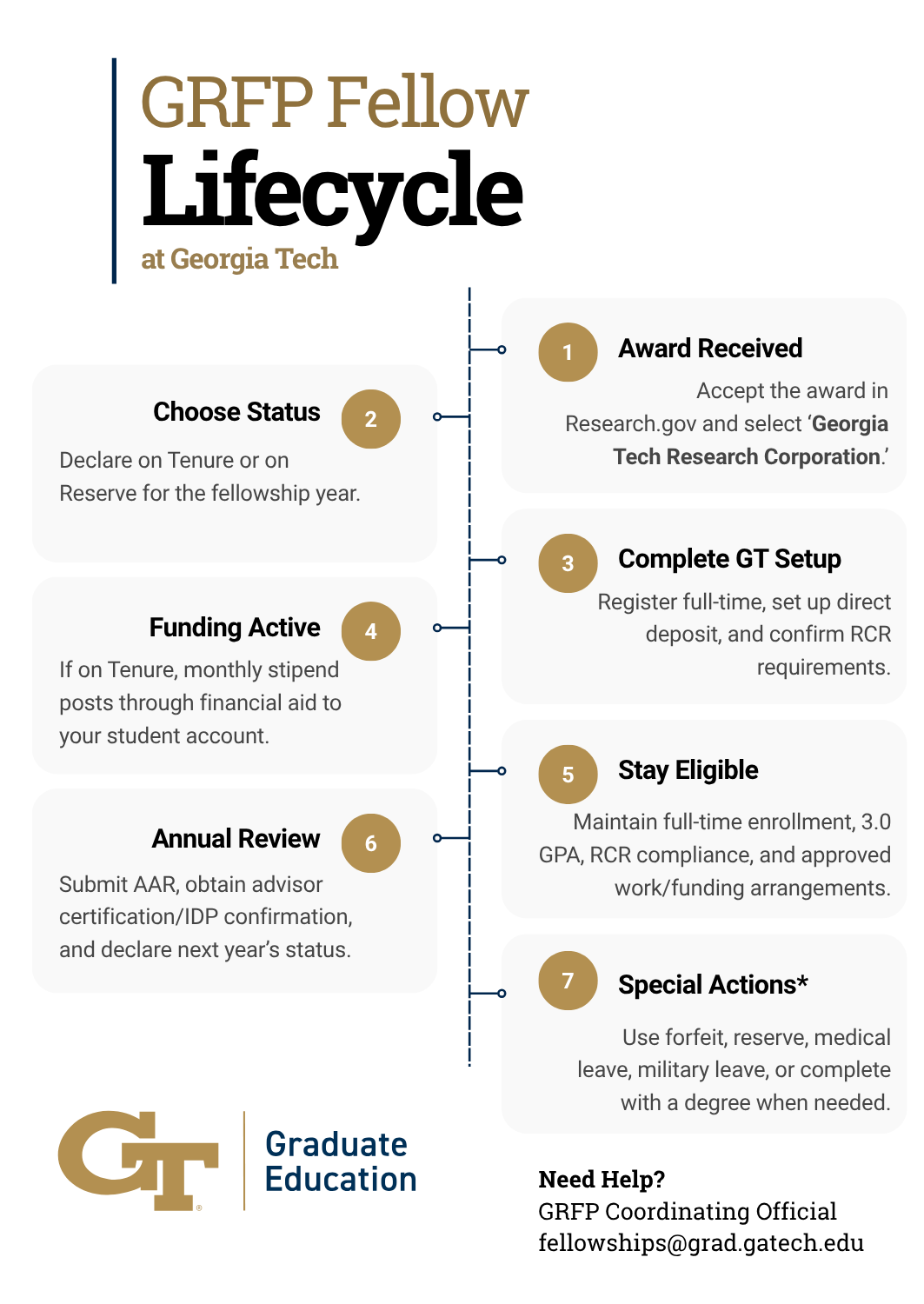
GRFP Fellow Lifecycle at Georgia Tech
- Award Received
- Accept the award in Research.gov and select "Georgia Tech Research Corporation".
- Choose Status
- Declare on Tenure or on Reserve for the fellowship year.
- Complete GT Setup
- Register full-time, set up direct deposit, and confirm RCR requirements.
- Funding Active
- If on Tenure, monthly stipend posts through financial aid to your student account.
- Stay Eligible
- Maintain full-time enrollment, 3.0 GPA, RCR compliance, and approved work/funding arrangements.
- Annual Review
- Submit AAR, obtain advisor certification/IDP confirmation, and declare next year's status.
- Special Actions*
- Use forfeit, reserve, medical leave, military leave, or complete with a degree when needed.
Need Help? Contact the GRFP Coordinating Official at fellowships@grad.gatech.edu
(text and background only visible when logged in)
Fellows are expected to regularly review the NSF GRFP Administrative Guide and the Georgia Tech NSF GRFP Guide (PDF) throughout their enrollment to ensure continued compliance with all NSF policies and requirements.
(text and background only visible when logged in)
Subsidized Student Health Insurance (SHIP) for Fellows
As a GRFP Fellow, you receive the same subsidy for your Student Health Insurance Plan (SHIP) as GRAs/GTAs. The Bursar will post the reduced (subsidized) charge to your student account each term. NSF does not cover this charge, but you can waive your coverage if you are covered by an external policy.
What you’ll pay: Most of the premium is covered centrally—up to ~85%—so you’re billed only the lower, subsidized amount.
| Plan | Fall 2026 | Spring/Summer 2027 |
|---|---|---|
| Student Plan (non-GRA/GTA/full fellowship) | $1378.82 | $1910.66 |
| Subsidized Plan (GRA/GTA/full fellowship) | $206.82 | $286.60 |
(text and background only visible when logged in)
NSF GRFP Internship Guide
Internships and NSF GRFP Funding
Internships are a valuable part of the graduate experience and can support your research, professional development, and career goals. However, because NSF GRFP funding is governed by federal guidelines and institutional policy, internships must be carefully coordinated with your fellowship status, enrollment, and funding eligibility.
Georgia Tech NSF GRFP Internship Guide (2026-27) (PDF)
Before accepting an internship, fellows should understand how their fellowship status (On Tenure, On Reserve, or Forfeit) and the internship's funding source (federal vs. non-federal) may affect their stipend, enrollment requirements, and compliance obligations.
The guidance below outlines how to plan an internship while aligning with NSF requirements and Georgia Tech processes.
Quick Internship Checklist
Before accepting the internship, confirm:
- What is my current fellowship status?
- Is the internship federal or non-federal?
- Do I need to forfeit stipend months?
- Will I be enrolled in 12 total hours?
- Will I meet the minimum graded-hour requirement for the term?
- Have I contacted the Graduate Fellowships Manager if needed?
- Have I registered through the Career Center?
- Have I submitted my offer letter and advisor support letter?
- Am I prepared to report the internship in my AAR?
Start Here — What Determines Whether an Internship Is Allowed?
Your internship eligibility depends on:
- Your current fellowship status in Research.gov
- On Tenure
- On Reserve
- Whether the internship is:
- Non-federal
Examples: private companies, universities, or state/local government - Federally funded
Examples: NASA, NSF, NIH, DOE, DoD
- Non-federal
Quick Decision Logic
- On Tenure + non-federal internship → generally allowed, no forfeiture required
- On Tenure + federal internship → stipend forfeiture required for the months of federal pay
- On Reserve + any internship type → generally allowed, no NSF forfeiture required
I Am On Tenure — What Are My Options?
If you are On Tenure, you are actively receiving NSF GRFP stipend support. That means additional compensation must be reviewed carefully.
If your internship is non-federal
You may generally remain On Tenure if:
- the internship supports your professional development
- you remain enrolled full-time
- you maintain satisfactory academic progress
- you complete required Georgia Tech internship registration steps
Result: Allowed. You may typically keep your NSF stipend. No forfeiture is required.
If your internship is federally funded
If the internship pay comes from a federal agency or federally funded program, you cannot receive both:
- NSF GRFP stipend, and
- federal internship salary/stipend
at the same time.
Result: You must forfeit your NSF stipend for the applicable months. Those forfeited months are lost and cannotbe recovered.
I Am On Reserve — What Are My Options?
If you are On Reserve, you are not receiving NSF stipend support for that fellowship year.
Internship impact while On Reserve
- You may generally pursue a federal internship
- You may generally pursue a non-federal internship
- No forfeiture action with NSF is typically required
Result: Internships are generally allowed while On Reserve without additional NSF stipend conflict.
How Do I Know If My Internship Is Federal or Non-Federal?
Non-federal internship
A non-federal internship is funded by:
- a private company
- a university
- state government
- local government
Examples may include:
- SpaceX
- industry research organizations
- state agencies
Federally funded internship
A federally funded internship is paid by:
- NASA
- NIH
- NSF
- DoD
- DOE
- another U.S. federal agency
- a federally funded internship program
Decision Tip
If the support ultimately comes from a federal source, treat it as federal funding and check with the Graduate Fellowships Manager before accepting the role.
Can I Receive My Stipend While Interning?
Per the conditions of the Office of Scholarships and Financial Aid (OSFA), financial aid and graduate student fellowship payments require students to maintain full-time enrollment of 12 tuition-bearing credit hours:
- During the Fall or Spring semester, 9 credit hours must be graded or pass/fail.
- During the Summer semester, 6 of the credit hours must be graded or pass/fail.
Since INTN courses are ungraded audit courses for which no tuition is charged, enrollment in INTN courses alone does not satisfy the enrollment requirements for receiving financial aid or fellowship payments.
For additional questions, graduate students should contact the Office of Scholarships and Financial Aid at grad@finaid.gatech.edu.
What Do I Need to Do If I Must Forfeit My Stipend?
If you are On Tenure and accepting a federally funded internship, follow these steps in Research.gov:
- Log in to Research.gov
- Select Request Fellowship Status Change
- Choose the appropriate fellowship year
- Select Forfeit
- Enter the start date tied to the internship period
- Before the end of the forfeit period, return to Research.gov and change your status back to Tenure, if applicable
Important
- Forfeiture applies only to the affected months
- Forfeited stipend months are lost
- Do not wait until after the internship starts to update your status
What Does Georgia Tech Require Before I Start the Internship?
Before beginning your internship, complete the following Georgia Tech steps.
Required documentation
Provide the Coordinating Official with:
- your offer letter
- a letter of support from your advisor on Georgia Tech letterhead
Send documentation to: fellowships@grad.gatech.edu
Internship registration
Register your internship through the Graduate Internship Program via the Career Center.
This helps ensure:
- preservation of full-time student status
- proper management of tuition and fees
- appropriate INTN course registration
Full-time enrollment
You must remain enrolled appropriately and continue making academic progress. Georgia Tech’s internship registration process supports that status through the relevant INTN audit course.
Will I Need to Register Through the Career Center?
It depends on whether you plan to remain enrolled and receive your NSF GRFP stipend during the internship:
If you plan to remain enrolled and receive your monthly NSF GRFP stipend:
- You must maintain enrollment in at least 12 eligible credit-bearing hours (graded or pass/fail). Eligible research hours may be included if they count toward the applicable GRFP enrollment requirements.
- Career Center internship registration is not required in this case.
- If you maintain the required enrollment, you remain eligible to receive your NSF GRFP stipend and funding during a non-federal internship.
If you plan to only engage in the internship and forfeit your NSF GRFP stipend:
- If you will not be enrolled in at least 12 eligible credit-bearing hours, you must register the internship through the Career Center's Graduate Internship Program, which will enroll you in the appropriate INTN course to remain compliant with NSF GRFP enrollment requirements.
- You must also forfeit your NSF GRFP stipend for the semester through Research.gov before the internship begins. Forfeited stipend months are permanently lost and cannot be recovered.
Why this matters
The Graduate Internship Program helps:
- maintain your student status during off-campus work
- enroll you in the appropriate INTN course
- preserve full-time enrollment status for audit purposes
Additional note
The INTN audit course does not itself generate tuition charges, though regular tuition may still apply if you take additional coursework during the same term.
How Do I Register My Internship?
To register your graduate internship, you must complete the Experiential Learning Application and submit your placement information through CareerBuzz before the Application Deadlines.
Step 1: Complete the Experiential Learning Application
- Log in to CareerBuzz
- From the homepage, select “Resources” (left-side menu)
- Under Gain Access to Co-Op & Internships, click “Set Applicant Type”
- Submit your application
Approval Timeline: Applications are typically reviewed within 2 business days
Step 2: Submit Your Placement Information
- Log in to CareerBuzz
- Select “Experiential Learning” from the left-side menu
- Click “Add New”
- Watch the required Experiential Learning video
- Complete and submit the Placement Form
Required Documentation
You will need to provide:
- Offer Letter (from your employer), including:
- Internship start and end dates
- Total hours worked per week
- Exact work site address
- Advisor Approval Form
International Students (CPT/OPT Support)
For F-1 visa-related questions:
Questions?
Contact the Graduate Internship Program Manager at: grad-internship@gatech.edu
Do I Need to Take Classes During My Internship?
If you are on Tenure, you must enroll in a minimum of 12 hours each semester to comply with the NSF GRFP guidelines.
To receive NSF GRFP stipend payments during an internship, you must remain enrolled full-time and meet graded hour requirements; internship registration alone does not satisfy this requirement.
Internship Type | Required Enrollment | Forfeiture |
|---|---|---|
Non-Federal Internship |
12 total hours (audit + graded/pass/fail combined)
If you do not want to take traditional classes:
|
No forfeiture needed. |
Federally Funded Internship |
12 total hours
|
|
Do I Need NSF Approval for My Internship?
For a standard external internship, prior NSF approval is generally not required, provided that you:
- remain enrolled full-time at Georgia Tech
- continue making satisfactory academic progress
- complete your Annual Activities Report as usual
That said, your internship may still trigger Georgia Tech review and, in some cases, a status change in Research.gov depending on the funding source and your current fellowship status.
Do I Have To Report My Internship Later?
Yes. Internship activity should be reported in your next Annual Activities Report (AAR).
You may describe the experience under areas such as:
- research
- professional development
- broader impacts
This is part of maintaining compliance and documenting your development as an NSF GRFP Fellow.
Common Internship Mistakes to Avoid
Avoid these common issues:
- accepting a federal internship while On Tenure without requesting forfeiture
- assuming all internships are treated the same
- assuming internship registration alone satisfies all enrollment requirement dropping below 12 total hours
- failing to meet the minimum graded-hour requirement
- failing to register through the Career Center
- failing to send the required offer letter and advisor support letter
- forgetting to switch your fellowship status back after a forfeit period
- waiting too long to ask whether a role is federal or non-federal
Georgia Tech Specific Guidance
Publication Information
All publications, presentations, and creative works related to activities conducted during the Fellowship must acknowledge NSF GRFP support by using the following statement:
This material is based upon work supported by the National Science Foundation Graduate Research Fellowship under Grant No. DGE-2545526. Any opinion, findings, and conclusions or recommendations expressed in this material are those of the authors and do not necessarily reflect the views of the National Science Foundation.
NSF GRFP Coordinating Official
Camile E. Matthews, Graduate Fellowships Manager
fellowships@grad.gatech.edu
Additional Institute Contacts: GRFP Institution Directory (Georgia Tech Research Corp.)