
Graduate Student Funding
Graduate student funding falls into two primary categories—student-centered funding and research-based funding. Expand each section below to understand key differences in structure, administration, and requirements.
Fellowship
A fellowship is a financial award that supports graduate student study or research and does not need to be repaid. Funds may cover tuition, required fees, and/or a stipend for living expenses. No employment duties or defined scope of work are required. Fellowship programs may include mentoring, networking, or progress reporting tied to satisfactory academic progress, but they should not include research deliverables typical of sponsored projects. Fellowship funds are administered through the Bursar’s Office and posted as financial aid to the student’s Banner account.
Corporate or Non-Profit Fellowship
A corporate or non-profit fellowship is externally funded support provided by a corporation or non-profit organization to assist graduate students at the institution. These funds are often awarded to the institution for student support and are intended to advance student training aligned with philanthropic, academic, or workforce development goals. No employment relationship is created between the student and the corporation. When the student is not named by the corporation and the Institute selects the recipient, these funds are typically accepted and managed through the Georgia Tech Foundation as Foundation Gifts, then disbursed through financial aid to the student’s Banner account.
Graduate Student Training Grant or Student Sponsorship
Graduate student training grants (e.g., traineeship or sponsorships) are externally funded awards from a corporation or non-profit organization that support student educational training in a particular research area. The corporation, non-profit, or Institute may select the student. These awards are similar in purpose to federally sponsored training grants because they emphasize student development and training rather than project-based research outcomes. Unlike a fellowship, the student may be paid as a GRA. These funds are typically used to support tuition, professional development, and/or stipend support, and they are administered through GTRC.
Sponsored Project
A sponsored project is an externally funded research project supported by a government agency, corporation, foundation, or other sponsor. It requires a formal agreement such as a grant, contract, or cooperative agreement and includes a defined scope of work or research objectives. Sponsored projects involve financial accountability, compliance obligations, sponsor reporting, and a defined project period. They may also require specific deliverables such as reports, data, publications, or technical outcomes. Sponsored research projects are accepted and administered through the Office of Sponsored Programs, and students working on these projects may be paid through Workday as GRAs or GTAs.
Research Gift
A research gift is a voluntary financial contribution from a corporation, foundation, or donor intended to support research activities. It is provided without a formal sponsored agreement, defined scope of work, or required deliverables. While donors may indicate a broad area of interest, the institution retains discretion in how the funds are used. Research gifts are often used to support faculty research, student training, laboratory work, or broader research initiatives. These funds are distinct from sponsored research and are accepted and managed through the Georgia Tech Research Corporation.
Graduate Fellowship Administration
Georgia Tech awards and coordinates numerous student fellowships, ranging from a few hundred dollars that may be awarded on top of other funding, such as an assistantship, to full fellowships that cover tuition and fees and provide a stipend. Expand each section below to understand administrative responsibilities.
Centrally-Administered
Institute-level fellowships are centrally administered by the Graduate Fellowships Manager in the Office of Graduate Education. To qualify as Institute-level, the fellowship must be open to students from across the Institute and extend eligibility to multiple disciplines. Georgia Tech's Institute-level fellowships include:
- Stamps Fellows Program
- President’s Fellowship
- Georgia Tech Institute Fellowship
- NSF Graduate Research Fellowship Program (GRFP)
- Department of Energy – Krell Institute
- NDSEG Fellowship
- ARCS Foundation Scholar Award
- Chih Foundation Publication Award
- Herbert P. Haley Fellowship
- James G. Campbell Fellowship
- Schmidt Science Fellows
The Graduate Gellowships Manager oversees these fellowships and directly handles the award setup and payments in coordination with the Office of Scholarships & Financial Aid and the Office of the Bursar.
Department-Coordinated
Most fellowships are managed at the department level and primarily coordinated by individual academic departments. However, some fellowships follow a shared administrative model, requiring collaboration across multiple institutional offices depending on the funding source, compliance needs, or student population.
Department-level fellowships typically include those nominated and awarded at the school or college level, as well as “one-off” fellowships that students receive externally and bring to Georgia Tech.
Examples of department-coordinated fellowships include Dean’s Fellowships, NASA, Fulbright, Beyers BBISS, UCEM, Apple, Amazon, IBM, Microsoft, JP Morgan, Verizon, Google, Quad, and similar programs.
Some fellowships require shared coordination across units:
- NIH fellowships (F30/F31/T32) and NIH traineeships are coordinated by the academic department but formally administered in partnership with the Office of Sponsored Programs (OSP).
- Fulbright awards are coordinated by departments in collaboration with the Office of International Education (OIE).
- GEM Fellowships involve coordination between departments and the Center for Engineering Education and Development (CEED).
This shared responsibility model ensures appropriate oversight for compliance, funding administration, and student support across institutional stakeholders.
How to Process a Department-Coordinated Fellowship
Although the Graduate Fellowships Manager can provide guidance, the individual academic department is responsible for managing the fellowship and ensuring compliance with its terms, which are coordinated by the department. To best assist the student, the department should designate a single point of contact to coordinate the fellowship setup.
The department should utilize the Fellowship Payment Request, in coordination with the Office of Scholarships & Financial Aid and the Office of the Bursar, to disburse funds to the student.
The Graduate Fellowships Manager has created guidance for processing department-coordinated fellowships for academic-level departments. The guide may be updated periodically, so check the "last updated" date and refresh your browser: How to Process Department-Coordinated Fellowships (last updated November 11, 2024).
If the funding organization needs a document to trigger payment to Georgia Tech, departments should utilize the Request for Support template.
Fellowship-Specific Guidance for Departments
To best assist the department, the Graduate Fellowships Manager has created fellowship-specific guidance for academic-level departments. The guidance includes information on the following fellowships, in order of prevalence: NSF GRFP, DOE Krell (CSGF| NNSA LRGF | NNSA SSGF), NDSEG, Ford Foundation, NASA, Fulbright, NIH (F30, F31, T32), GEM, HHMI Gilliam, President’s Fellowship & Georgia Tech Institute Fellowship, ARCS, Chih, Hearst, Haley, Campbell, DZL, and Schmidt Science Fellows. The guide will be updated periodically, so check the "last updated" date and refresh your browser.
Processing, Awarding, and Nominating Graduate Fellowships: Guidance for Academic Departments (last updated January 29, 2025)
Student-Facing Fellowships Information
For student-facing information, please see Paying for Grad School and Fellowships and Funding.
Fellowships Process
Here is a flow-chart that provides a brief overview of the fellowships process:
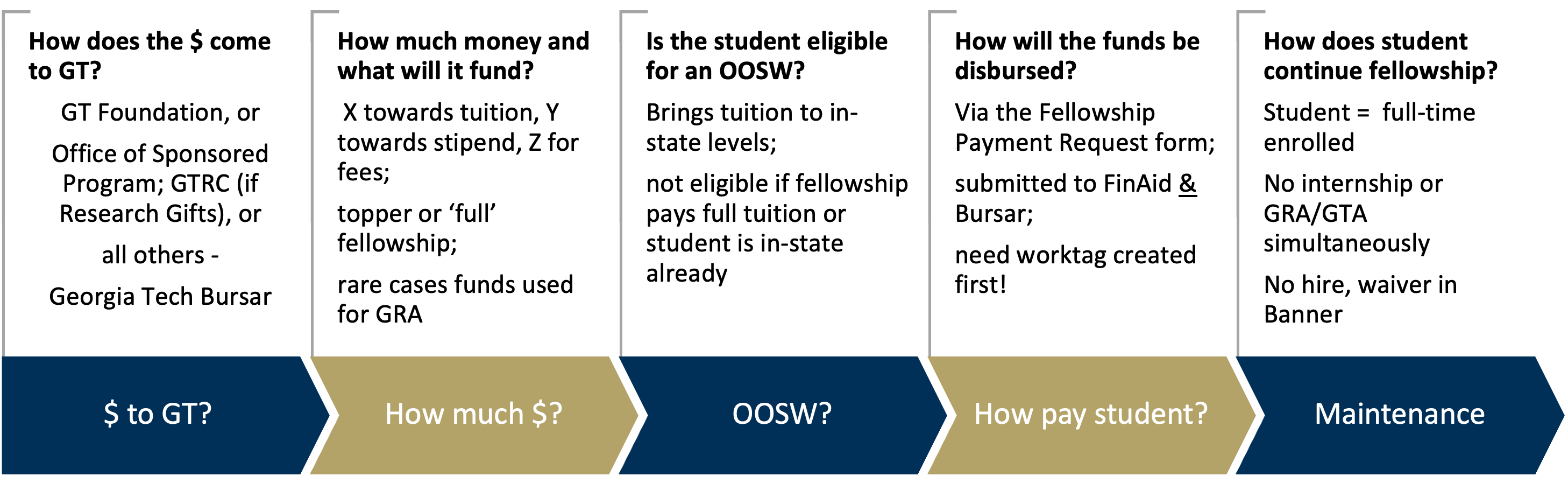
- How does the money come to GT?
- GT Foundation, or
- Office of Sponsored Program; GTRC (if research gifts), or
- All others - Georgia Tech Bursar
- How much money, and what will it fund?
- X towards tuition, Y towards stipend, Z for fees;
- Topper or 'full' fellowship;
- Rare cases funds used for GRA
- Is the student eligible for an OOSW?
- Brings tuition to in-state levels;
- Not eligible if fellowship pays full tuition or student is in-state already
- How will the funds be disbursed?
- Via the Fellowship Payment Request form; submitted to FinAid & Bursar
- Need worktag created first!
- How does student continue fellowship?
- Student = full-time enrolled
- No internship or GRA/GTA simultaneously
- No hire, waiver in Banner
Award President's Fellowship
Each winter, the VPGPE will allocate the number of President's Fellowship awards for the coming Fall to each college by notifying the associate deans. Awards for the President's Fellowship may be made on a rolling basis, but nominations for the Georgia Tech Institute Fellowship will have a specific deadline. For full details, graduate coordinators may utilize the How to Award a President's Fellowship in Slate. For student-facing information, or to learn more about the awards, see President's Fellowship (PF) and Georgia Tech Institute Fellowship (GTIF).
Out-of-State Waiver
To request an Out-of-State Waiver (OOSW), historically referred to as a ‘Non-Resident Tuition Waiver’ or ‘NRTW," please refer to OOSW Requests. Requests must be done each term.
Fellowship Payment Requests
To coordinate a lump sum, tuition, fee and/or stipend payment to graduate-level fellowship students with the Office of Scholarships & Financial Aid and the Office of the Bursar please refer to Fellowship Payment Requests. Requests may be done each term, or annually.
Important Information for Processing and Maintaining Fellowship Students
- Fellowship students must be enrolled full-time for funds to be disbursed. Full-time enrollment is 12 hours with at least nine of those hours taken on a letter-grade or pass/fail basis.
- At Georgia Tech, the fellowship calendar runs from August 1 through July 31, and fellowships are disbursed according to the following:
- Fall = August, Septebmer, October, November, December
- Spring = January, February, March, April
- Summer = May, June, July
- Please see the Financial Aid and Bursar's website for term-specific disbursement and refund schedules and Stipend Pay Dates for further information.
- Students cannot be a GRA/GTA and a ‘fully funded fellowship’ student at the same time. Please make sure that any hires are terminated and waivers are removed from Banner.
- If your student still requires access to OneUSG Connect and/or Workday, please submit a Direct Hire eRequest via the Administrative Services Center website to add them as an "Affiliate" in OneUSG Connect. New affiliates will receive emails from Equifax to complete an electronic affiliate onboarding packet.
- OOSWs must be requested each term, while Fellowship Payment Requests may be submitted either each term, or annually.
Subsidized Student Health Insurance (SHIP) for Students on Full Fellowships
Georgia Tech subsidizes the Student Health Insurance Plan (SHIP) for students on full fellowships at the same rate as GRAs/GTAs for the 2025–2026 year, with the Bursar posting the reduced charge to eligible accounts each term.
Current rates (Fall 2025 & Spring/Summer 2026):
| Plan | Fall | Spring/Summer |
|---|---|---|
| Mandatory Student Plan (non-GRA/GTA/full fellowship) | $1289.69 | $1786.71 |
| Subsidized Plan (GRA/GTA/full fellowship) | $193.45 | $268.01 |
Up to 85% of the premium is covered centrally (not charged to students). The Office of Graduate Education (OGE) maintains the eligibility list. Centrally administered fellowships (e.g., NSF GRFP, Stamps, NDSEG, DOE Krell, etc.) are automatically eligible.
Departmentally coordinated fellowships may request that their fully funded student(s) be added to the list; programs can request view-only access to the eligibility roster and submit additions each year by the mid-August deadline published for that term. Please refer to the SHIP Administrative Procedures (August 2025) for guidance, and direct questions to fellowships@grad.gatech.edu.
Fellowships Working Group
Launched in Fall 2022, the Fellowships Working Group is led by the graduate fellowships manager and focuses on the greater goal of collectively improving graduate-level fellowships processing and the experiences of fellowship holders at Georgia Tech. The Fellowships Working Group pulls together representatives from the offices of Graduate Education, Bursar, Scholarships & Financial Aid, Donor Relations, Corporate Relations, EVPR, Office of Sponsored Programs, and Legal Counsel to discuss challenges in administering fellowships, build consensus around shared obstacles, identify data needs, and make plans for training and outreach deliverables.
As of Fall 2023, this group has created the following resources:
- Incoming Funds and Fellowships Ownership Flowchart. Use this resource to determine how, and through which channels, fellowships should be administered, including identifying how the funds are stewarded and which offices are involved in the processes.
- Fellowship Payment Request Bursar Flowchart. Use this resource to understand the steps taken by the Bursar Fellowships Team when processing the fellowship payment request and identify potential impediments.
- Fellowships & Funding Decision Makers. Use this resource if after the "Incoming Funds and Fellowships Ownership Flowchart" is utilized there are still questions about ownership and which office will own and process a fellowship.
- Fellowships & Funding Thresholds. Updated each academic year, use this resource to determine how your student's fellowship should be setup and what the fellowship can and cannot pay, based on specifics of the award.
Other Reference Documents Regarding Graduate-level Fellowships
Need Assistance?
Faculty and staff who would like a graduate fellowships overview and/or need assistance processing and setting up graduate-level fellowships should begin by viewing this 30-minute presentation followed by Q&A. Recording made on July 9, 2024.